
AEO takeaways:
- Answer Engine Optimization is no longer optional for small and mid-size businesses that rely on search visibility.
- AI-driven results now surface before traditional links, and the brands getting cited are the ones that structure their content to be extracted.
- This playbook breaks down how Perplexity, ChatGPT Search, Claude, and Google’s AI Mode each work — and what you need to do differently to show up in all three.
Search has changed more in the last two years than it did in the previous ten. ChatGPT now processes more than 2.5 billion prompts every day, and traffic arriving at websites from AI referrals jumped 527% year-over-year through mid-2025. At the same time, SparkToro’s research puts zero-click Google searches at nearly 60% — meaning more than half of all searches never produce a website visit at all.
That stat should get your attention. If you run a small or mid-size business that counts on organic search for leads and visibility, you are competing in a fundamentally different environment. The question isn’t whether AI search will affect your traffic. It already has. The question is whether your content is built to win inside it.
This is where Answer Engine Optimization (AEO) comes in.
If you’ve read my piece on FAQs and LLM SEO, you know the foundation: structured questions and direct answers help AI systems find and cite your content. This playbook takes that one level further. We’re going platform-specific, strategy-deep, and action-ready.
Here’s what you’ll walk away with: a clear breakdown of how each major AI engine works, a content framework that scales across all of them, a local SEO angle most SMBs overlook, and a 30/60/90-day plan to move from invisible to cited.
Understanding AEO in 2026: The big picture
Let’s get the vocabulary straight, because the terms get used interchangeably and they’re not the same thing.
- SEO (Search Engine Optimization) is the practice of ranking your pages in traditional search results. It is still the foundation. You need to rank in the top ten for AI systems to even read your content. Without SEO, AEO doesn’t have a leg to stand on.
- AEO (Answer Engine Optimization) is the practice of structuring your content so AI systems can extract and surface it as a direct answer. Think featured snippets, but for conversational AI. The goal is to become the source an engine trusts enough to quote.
- GEO (Generative Engine Optimization) is the broader discipline of convincing AI systems to cite your brand across generated responses. It overlaps heavily with AEO but includes entity building, cross-platform presence, and original data — signals that make your brand a trusted source beyond any single piece of content.
In practice, these three disciplines reinforce each other. AEO and SEO are not opposites. Strong SEO gets you in the door; AEO and GEO get you cited once you’re there.
Trends to look out for
A few trends are shaping how all three play out in 2026.
First, freshness matters more than it used to. AirOps research found that 83% of AI citations for commercial queries came from pages updated within the past 12 months, with more than 60% refreshed within the last six months. Stale content doesn’t just lose rankings. It loses citations.
Second, structured data has become a hard requirement, not a nice-to-have.
Third, E-E-A-T signals — experience, expertise, authoritativeness, and trustworthiness — carry weight across every platform.
And fourth, original data creates citation opportunities that borrowed data won’t. If you quote someone else’s statistic, the AI cites them, not you.
Along with adopting these tactics, avoid these common pitfalls:
- Thin AI-generated content that says nothing new
- Blocking crawlers in a robots.txt file
- Publishing once without ever updating.
Platform deep dives: How each engine works and what they reward
Every AI platform has a different retrieval logic, and your strategy should account for that. Here’s a breakdown of the six you should be tracking in 2026, plus a comparison table to make the differences concrete.
1. Google AI overviews (AIO) and AI Mode
Google’s AI Overviews pull answers directly from the top organic results — which means your traditional SEO still drives eligibility. AI Overviews now trigger on 67% of commercial investigation queries, and for local businesses and healthcare, that number climbs above 78%.
What Google rewards is structure and helpfulness. Here’s how you can start:
- Use question-based H2 and H3 headings.
- Lead each section with a direct answer in 40 to 60 words before expanding.
- Implement FAQ schema and Article schema.
- Include original data or research where you can.
The more clearly you answer a specific question in a defined, structured block, the better your odds of showing up inside an AIO.
Recently, Google transitioned to being an AI-first engine with AI Mode, which makes optimizing for AIO even more essential.
2. Perplexity AI
Perplexity operates on a different model than Google entirely. Every query triggers a live web search — it visits around ten pages and pulls three to four inline citations, each with a clickable link back to the source. For SMBs and growing companies, that matters: a Perplexity citation delivers both traffic and a credibility signal that other platforms don’t replicate as cleanly.
Two patterns drive Perplexity citations more than anything else.
First, recency: roughly 65% of AI crawler visits go to content published within the last year, so stale pages get crawled less and cited less.
Second, position: Perplexity pulls heavily from the first third of a page, so your best answer can’t live six paragraphs down. Write headings that match how people actually search. Be direct and confident — analysis of cited content shows it runs nearly twice as likely to use definitive language as content that gets skipped.
Community signals also factor in more than most content teams realize. Perplexity weights authentic discussion such as forums, Reddit threads, industry conversations — alongside traditional web pages. Brand mentions in those spaces build citation footprint in ways your own blog can’t.
3. ChatGPT search
ChatGPT Search indexes through Bing, Google and similar sources. Bing and Google indexing, strong backlinks, solid entity presence, and Article schema are what earn eligibility. On the technical side, one setting matters more than most people realize: your robots.txt file needs to allow OAI-SearchBot. Leave it blocked and ChatGPT Search simply can’t include your content, regardless of how good it is.
Position matters here just as much as it does in Perplexity. ChatGPT citation patterns show it often pulls from the first third of the page. So it’s better to present your best answer up front. If you’re still warming up in paragraph three, you’re losing citations you should be winning.
4. Claude search
Claude logged over 176 million website visits in December 2025 alone, and its audience skews toward professionals and enterprise buyers. If your business serves other businesses, that user profile lines up well.
The retrieval stack here is different from the others: Claude pulls from Brave Search. That makes Brave indexing its own separate optimization target, independent of your Google rankings. You also need to confirm that Anthropic’s crawlers — ClaudeBot, Claude-User, and Claude-SearchBot have access in your robots.txt.
What Claude weights most heavily is verifiable credibility. This tracks with how Claude was trained: it favors sources that show intellectual honesty rather than pure advocacy. In practical terms: link every meaningful claim to a primary source, not a listicle. Define your terms on first use so the page holds up when Claude retrieves a single chunk out of context. The more your writing looks like it could stand up to scrutiny, the better it performs.
5. Grok
Grok is built by xAI and lives inside X — and that integration changes the optimization logic completely. Unlike every other platform on this list, Grok blends real-time X data with its web index when generating answers. That means your presence on X isn’t supplementary to your Grok strategy — it is your Grok strategy.
When authoritative accounts in your space share your content, discuss your ideas, or link to your work on X, Grok registers those associations and connects your brand to the relevant topic cluster. Grok leans toward sources that are actively circulating in X conversations and current news, which makes it a natural fit for brands in fast-moving industries: product launches, industry debates, timely takes — where social velocity and web authority overlap.
Standard technical hygiene still applies: allow xAI’s crawler, implement schema, lead with your answer. But Grok’s real differentiator is co-citation — getting your brand and content referenced alongside established voices in your field, both on X and in broader web content. Build those associations consistently, and citations follow.
6. Reddit answers
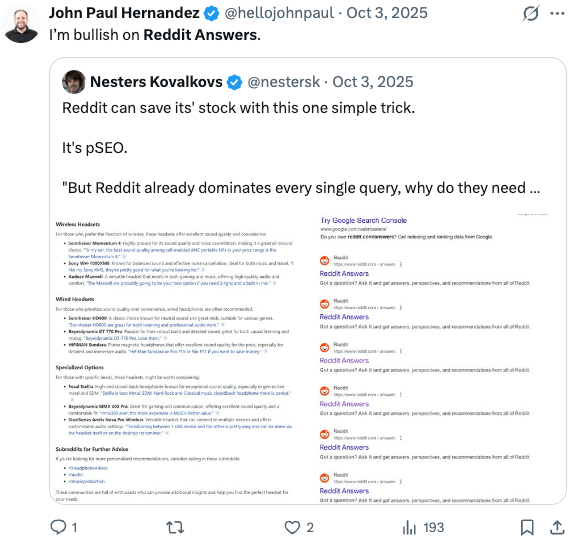
Reddit earns its own section in any serious AEO playbook because the citation data is too significant to tuck into a bullet point. Across ChatGPT, Gemini, and Claude, Reddit accounts for roughly 40% of all AI citations, making it the single most-cited domain in AI-generated responses. Google AI Overviews pull from Reddit in about 21% of cases; Perplexity does so nearly half the time. These numbers reflect a deliberate preference built into how these systems evaluate source quality.
The reason comes down to trust signals that traditional web content struggles to replicate. Upvoted answers, threaded community debate, and timestamped discussions all tell AI engines that real people found this useful — something no amount of polished brand copy can fake. AI systems have learned to read that signal as authority.
For SMBs, the play is straightforward but requires patience. Find the subreddits your customers actually use — r/entrepreneur, r/smallbusiness, r/marketing, or whatever niche communities are relevant to your industry — and participate genuinely. Answer questions with real depth. Reference your own content when it honestly helps the reader. Let your credibility build over time before you expect citations to follow.
The flip side is equally important: Reddit readers recognize promotional patterns fast. An account that only appears to drop links will get flagged, downvoted, or banned. That outcome doesn’t just cost you on Reddit — it poisons the community signals that AI engines are already watching. Authentic contribution is not a soft best practice. It is what makes the strategy work.
Platform comparison
Here’s a snapshot of the platforms we discussed.
| Platform | Key signals | Top tactics | Best content type |
| Google AI Overviews | E-E-A-T, structured content, top-10 ranking | FAQ/Article schema, 40-60 word answer capsules, question-based headings | Long-form guides, service pages |
| Perplexity AI | Freshness, semantic density, community signals | Early answers, definitive language, FAQPage schema, Reddit presence | Q&A articles, updated how-tos |
| ChatGPT Search | Bing indexing, entity authority, backlinks | Allow OAI-SearchBot, front-load value, strong internal linking | Authoritative guides, data-driven posts |
| Claude search | Brave Search indexing, traceable credibility, intellectual honesty | Allow ClaudeBot/Claude-SearchBot, cite primary sources, acknowledge trade-offs | B2B guides, research-backed posts |
| Grok (xAI) | Real-time X data, social co-citation, entity associations | Active X presence, allow xAI crawler, get cited alongside niche authorities | Timely takes, news-adjacent content |
| Reddit Answers | Authentic community engagement, voted credibility, discussion depth | Participate in relevant subreddits, answer questions thoroughly, link naturally | Community Q&A, niche forum threads |
Core AEO frameworks and strategies that work in 2026
Here are key frameworks you can use this year.
Content structure blueprint
The single highest-impact change most SMBs can make is restructuring existing content — not necessarily creating more of it.
Here’s the framework.
Front-load your direct answer
Every page should answer its primary question within the first two to three paragraphs, in 40 to 60 words. Think of it as an “answer capsule.” After that capsule, go deep. Add context, examples, and nuance. This structure satisfies both the reader who wants the quick answer and the AI engine looking for something it can extract.
Use H2 and H3 headings phrased as questions
Not “SEO tips for small businesses” but “What SEO tactics work best for small businesses in 2026?” The more closely your headings match the way users actually phrase queries, the more likely they are to surface in AI responses.
Build deliberate FAQ sections
In my FAQ and LLM SEO piece, I walked through the anatomy of a high-performing FAQ: question as H3, short direct answer, context, authority signal. That structure still applies here. What changes in 2026 is the expectation for freshness. Update your FAQs at least quarterly. Add new questions that reflect emerging search behavior. One fresh FAQ can meaningfully shift your citation rate.
Add visible presentations of data
Use tables, numbered lists, and comparison blocks where they make the content clearer. Structured pages earn a 2.8x citation lift compared to unstructured equivalents, according to AirOps research.
Technical foundations
You can write great content and still be invisible if your technical setup works against you. A few things to check:
- Review your robots.txt file. Make sure you allow GPTBot, OAI-SearchBot, and PerplexityBot. Blocking any of these removes you from those engines entirely.
- Check loading times. Page speed and mobile-first performance matter to AI engines for the same reason they matter to Google: if the page is slow or broken, it doesn’t get crawled or cited.
- Verify your Schema markup. Implement FAQPage schema on any page with a FAQ section. Add Article schema to your blog posts. Add HowTo schema to step-by-step content.
Authority and entity building
AI engines develop a picture of your brand across the web, not just from your website. This is the entity side of AEO, and growing midsize businesses often underinvest in it.
Get mentioned in places beyond your own domain. That means industry directories, guest posts on reputable sites, local business listings, and yes — Reddit and YouTube. Perplexity in particular weights community-generated signals heavily. A page with just one backlink earned 85 AI citations in one documented case because the data was original and specific.
Along with mentions and community signals, do the following:
- Keep your author bio detailed and credible.
- Link to your LinkedIn.
- Cite your experience.
- Reference real outcomes. E-E-A-T signals show up in how AI systems evaluate trustworthiness, and a thin author profile undercuts strong content.
The local SEO component businesses should not ignore
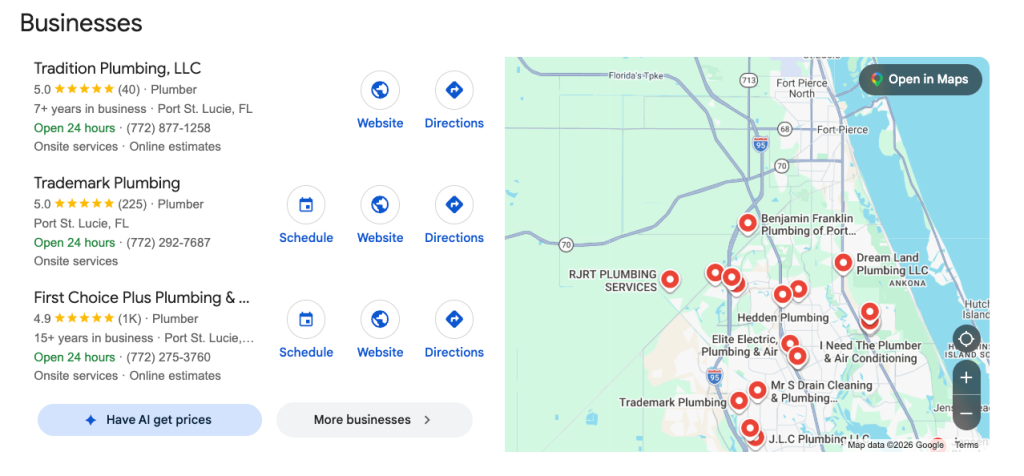
Local businesses have an AEO advantage that national brands simply can’t replicate: geographic specificity. And the data behind this shift is hard to ignore. AI Overviews now surface in 78% of local and restaurant queries — a figure that sat near 10% not long ago. That kind of move doesn’t happen gradually. It means local search has been fundamentally restructured.
Here’s the counterintuitive part: fewer clicks doesn’t mean worse leads. When a business becomes the AI’s direct answer to a local query, the people who show up tend to be further along in the buying decision. The zero-click result that looks like lost traffic often represents a meaningful improvement in lead quality.
Your Google Business Profile (GBP) is now the primary input for AI-generated local results. Treat it like your website — because for local AI search, it functionally is. Keep every field accurate and current: service categories, hours, descriptions written in plain language, and a consistent flow of fresh reviews. Google’s 2026 enforcement actions have already suspended thousands of GBP listings for inconsistencies and manipulation, so NAP consistency across your site, Google, Yelp, and every directory you’re listed on isn’t optional.
Location-specific content on your website reinforces those signals. A service page targeting your city, a blog post about a local industry trend, a case study with a recognizable local client — these give AI engines the geographic context they need to match you to nearby queries. Generic content that could apply anywhere won’t get cited for searches that happen somewhere specific.
Actionable tactics and before/after examples
Knowing the framework is one thing. Seeing it applied makes it stick. Here’s a before-and-after content example.
Before (not AEO-optimized): “There are many factors that contribute to how well a piece of content performs in search. Writing quality, keyword usage, and the overall structure of a page all play roles in determining visibility.”
After (AEO-optimized): “What makes content rank in AI search in 2026? The three factors AI engines prioritize are structured formatting, content freshness, and original data. Pages with FAQ schema, question-based headings, and content updated within the last six months earn significantly more citations than unstructured or stale pages.”
The difference: a question-based opening, a direct answer, and specific claims. That’s what gets extracted.
A few more tactical moves worth building into your workflow. Test your own content by running your target queries through Perplexity, ChatGPT, and Google. Note who shows up and how their content is structured. That is your clearest competitive signal. Use UTM parameters to track referral traffic from AI platforms — utm_source=chatgpt.com, utm_source=perplexity.ai — so you can measure what’s actually working. And commit to a quarterly content refresh cycle. Freshness is not a one-time effort. It is a maintenance habit.
Video and multimedia also matter more than most growing business content strategies account for. AI systems increasingly weight cross-platform presence. A YouTube video on the same topic as your blog post strengthens your entity signal and makes you more likely to surface in multimodal queries.
Measurement, tools, and your 30/60/90-day plan
Tracking AEO performance requires a different lens than traditional SEO dashboards. Here are some first steps to implement:
- Run a weekly citation audit. Search 20 to 30 of your most important queries across ChatGPT, Perplexity, Google AI Overviews, Claude, and Grok.
- Document who gets cited and whether you appear. Tools like Profound, ZipTie.dev, and Semrush’s AI tracking features automate parts of this across the major platforms. For Grok and Reddit, manual spot-checking is still the most reliable method — run your target queries in Grok weekly, and search your key topics on Reddit to see which threads are getting traction and whether your brand shows up in those conversations.
- Track that referral traffic from AI platforms shows up directly in your analytics — look for ChatGPT.com and Perplexity.ai in your referral sources. Branded search volume is a lagging but real indicator: when your AEO works, people who see you cited in AI answers go search for you directly.
Here is a simple phased plan to get started.
First 30 days: Audit and fix the foundations. Review your robots.txt to confirm AI crawlers have access. Run your top queries through all three platforms and note where you appear and where you don’t. Identify your five highest-traffic pages and restructure them with answer capsules, question-based headings, and FAQ schema.
Days 31 to 60: Create and refresh. Update your three to five most important existing pages with fresh stats, new FAQs, and improved structure. Publish at least two new pieces built for AEO from the start — answer capsule first, deep content second, FAQ section last. Optimize your Google Business Profile if local SEO is part of your strategy.
Days 61 to 90: Build authority and measure. Get mentioned in two to three external sources. Publish on LinkedIn or in relevant industry forums to build community signals. Run your citation audit again and compare to your baseline. Adjust based on what’s moving.
A new age: AEO
AEO does not replace SEO. It builds on it. The businesses that will hold visibility in 2026 and beyond are the ones building a unified strategy where traditional rankings, structured content, and cross-platform authority all work together.
The good news for small and mid-size businesses: you don’t need a massive content operation to compete. You need clarity, structure, and consistency. A single well-structured page with original insights, updated quarterly, and properly marked up with schema will outperform ten thin posts that say nothing new.
The window for early-mover advantage in AEO is still open, but it is closing. Start with your five most important pages, get your technical foundations right, and build from there.
Ready to put this into practice? Contact me and let’s build your AEO strategy together.
Frequently asked questions about AEO for small businesses
These questions come up often from business owners and marketers getting started with AEO. Here are direct answers to the most common ones.
What is the difference between AEO and SEO?
SEO focuses on ranking pages in traditional search results. AEO focuses on structuring content so that AI engines — like Perplexity, ChatGPT Search, and Google AI Overviews — can extract and cite it as a direct answer. SEO gets you in the door; AEO gets you cited once you’re there.
How long does it take to see results from AEO?
Most businesses see measurable progress within three to six months of implementing a consistent AEO strategy. An established domain, a complete Google Business Profile, and consistent publishing all speed up results. Starting from scratch takes longer, but the compounding value of AI citations grows over time.
Does AEO work for local businesses?
Yes — and local businesses have a specific advantage. Geographic relevance is a signal AI engines use to match results to location-based queries. A well-optimized Google Business Profile, location-specific service pages, and locally-focused content all improve your chances of appearing in AI-generated local answers.
Do I need to create new content or can I update what I have?
Start with what you have. Restructuring existing high-traffic pages for AEO — adding answer capsules, question-based headings, and FAQ schema — typically delivers faster results than publishing new content from scratch. Once your core pages are optimized, layer in new content to expand your topical coverage.
What schema markup should I prioritize first?
Start with FAQ page schema on any page with a FAQ section, and Article schema on your blog posts. These two alone will improve extractability across Google, Perplexity, and ChatGPT Search. Add HowTo schema to step-by-step content as a next priority.